Versioned templates
Compliance, internal audit, or classroom-observation templates, cloned and activated per cycle.
09 · Compliance you can search, not scramble for.
Schedule inspections and follow each action through to its closure.
Hear it from Syfty
Why it matters
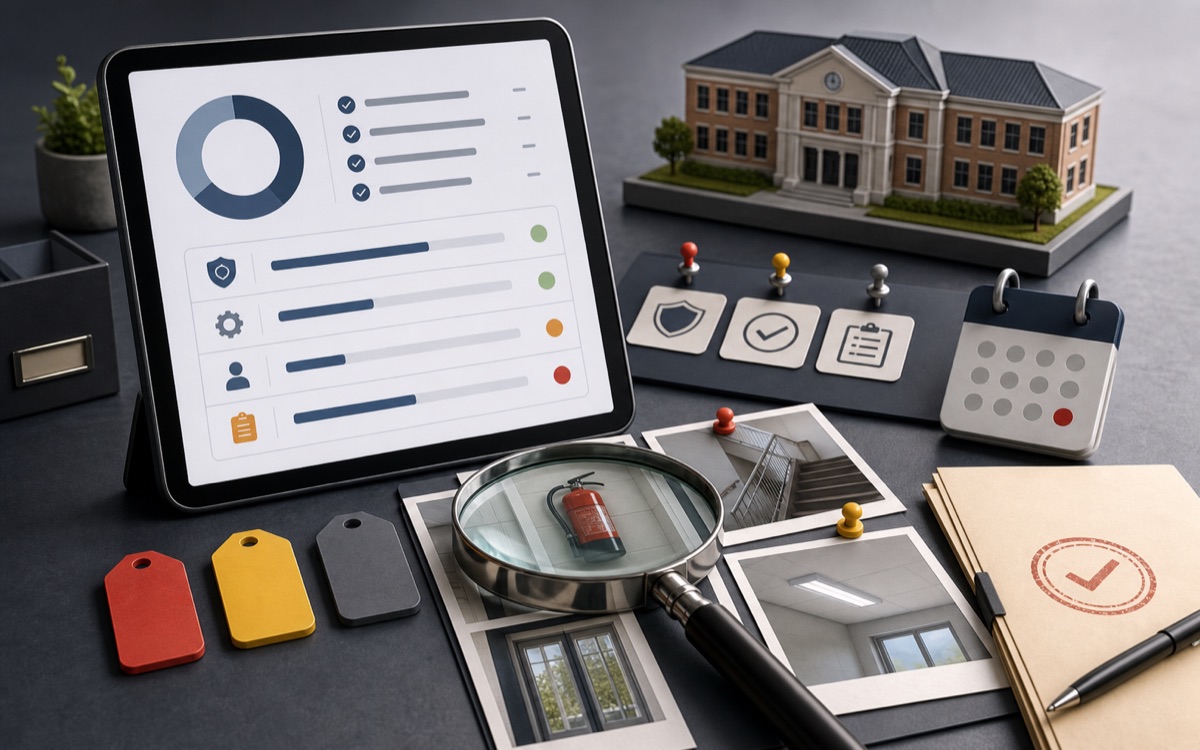
A compliance visit or an internal audit only creates value if its findings actually get fixed, and that depends entirely on whether anyone can find, months later, what was found and what happened next. Edsyft builds inspections as versioned templates: a compliance checklist, an internal audit, or a classroom observation, cloned and activated for each cycle so last year's version stays exactly as it was even after this year's gets edited.
Every report moves through a deliberate, one-directional status path: draft, submitted, under review, reviewed, and finally published, and that transition is driven entirely by the organization side; a school can fill in and submit its own responses, but it cannot push a report from reviewed to published itself. Scoring can be weighted by section or averaged as a rating, and specific items can require evidence before they're considered answered at all.
A finding that needs to be fixed becomes an action item with an assignee, a severity, and a due date, not a line buried in a PDF. The school responds with notes and evidence, and the organization then explicitly accepts that response or rejects it with a reason, in which case the school can respond again. Nothing about the finding actually closes without that back-and-forth being resolved, on the record.
Visibility is deliberately its own decision, separate from status. A report can be fully published and still invisible to the school it's about, until the organization takes the specific extra step of sharing it, so a report can move all the way through review internally before anyone at the campus ever sees a finding attached to their name. Every one of these transitions, shares, and responses is written to an event log that can't be edited after the fact, which is what makes a compliance review a search through history instead of a scramble to remember what was agreed.
What it handles
Every capability below maps to a real operating decision, handoff, or record inside the module.
Compliance, internal audit, or classroom-observation templates, cloned and activated per cycle.
Weighted scoring or rating averages, with evidence attached where it's required.
Recurring inspections: weekly to annual, assigned across multiple campuses at once.
Each finding gets an assignee, a severity, and a deadline, not just a note in a report.
A school responds to a finding with evidence; the organization accepts, or rejects with a reason and lets the school respond again.
The organization chooses whether a report is visible to the school, independent of how far along it is.
A report, from draft to published
Status moves in one direction, and only the organization can advance it. Schools can respond to findings, but they cannot publish the report.
01
Template is filled in; org can still edit freely.
02
Locked in from further edits, ready for review.
03
Org reviews responses and scores against the template.
04
Review is complete; report can be shared or held internal.
05
Final state, terminal, with visibility a separate decision.
How it is controlled
Permissions, approvals, and state changes are part of the workflow itself, not instructions left for a staff meeting.
A report can reach its final status and still be invisible to the school, sharing it with them is a separate, deliberate action.
If the organization rejects a school's response to a finding with a reason, that finding reopens for another response. It isn't a dead end.
Weekly through annual schedules assign the same template across multiple campuses, so a compliance cycle doesn't rely on someone remembering to start it.
Value propositions
What changes for the team once this module is running in daily work.
Every status change, share, and response on an inspection: who, what, and when, is recorded and can't be edited after the fact.
Leadership sees which campuses have open findings past their deadline, without asking for a status update.